Biography of Arthur Peacock Jester
 This is a picture of Arthur Peacock Jester. No one ever knew where his middle name came from. He never told anyone why his mother gave him that name.
However, in December of 2018 while researching the WALLS family, I found that Clara L. Peacock is listed as Niece residing with John Walls in the 1900 Census. It would seem that his mother gave him his middle name in honor of her cousin.
Arthur was born on the 8th of January 1898. He is said to have been born on the cape of Rich Neck in Talbot County, Maryland, but this has not been proved. Since his parents spent most of the time in Queen Anne’s county, it is possible this is simply family fiction. It seems more likely that he was born around the Crumpton area
He was the second son of Edward Price Jester and Annie Walls. Following his brother Wallis by 8 years.
Very little is known of his young years. He is known to be living in Baltimore with his father and mother in 1908. In 1908, the family business was a livery stable. Edward was a good blacksmith and was said to be excellent with horses. It seems reasonable to assume that the boys, both Wallis and Arthur, would work with their father in taking care of the horses and maintaining the livery. Later in life, Wallis took care of thoroughbred horses that had become anxious. He was very good with them and had a reputation for being able to restore a horse to racing form in less than 6 months.
When Arthur was older, he became the head of the shop. He was a master mechanic by that time and knew as much or more about automobiles as the best engineers. It was his job to ensure that all vehicles that came in for service, went out in better than factory condition. He had to certify that the vehicle had been “Jesterized.” While this was definitely a “marketing gimmick,” the idea was that every vehicle that came into the shop got a multi-point inspection. Any other items found would be documented, an estimate of repair cost determined, and the customer would be informed either by telephone or when picking up the vehicle.
After his father’s death in 1937, he and his brother Wallis ran the dealership. The business did very well, even during the war. They made a few sales to the local military, but most of the business was service: keeping the now aging automobiles running properly. A shortage of parts made things tough, but the Jester’s were always able to get the job done.
After his first wife, Eva Mason died in 1936, Arthur remarried. He married a lady named Marie Johnson. I know very little about her. Dad was 15 when his mother died, and he never liked the fact that his father remarried. While they got along, it was not a great relationship.
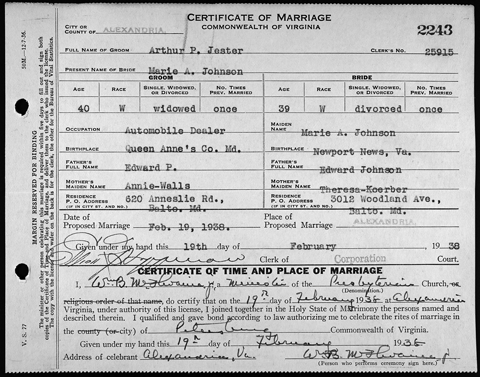
According to the marriage license, there were married in Alexandria, Virginia on the 19th of February 1938. Her full name is Marie Antoinette Johnson.
The story dad told was that his father met her in a bar on Baltimore Street. At that time, Baltimore Street was known for its burlesque houses, bars and other infamous dives. I don’t doubt that my grandfather frequented this area often, but I remember Marie as a caring person and not at all “rough” around the edges. Her daughter was also very nice. I seem to recall her name as Evelyn and her husband as Junie. I think he was a plumber. I believe their last name was Cousins.
I did some research and found the Cousins, Charles and his wife Karen. They had practically no knowledge about Marie and were happy that I could supply them with additional information. They also had the story that she met my grandfather at a bar on Baltimore Street. This seems to authenticate the story dad told.
In 1947, Arthur bought 4 lots on Kent island in the 4th election district of Queens Anne’s county, in Coxes Neck. They were lots numbers 23, 24, 25 and 26, of “Benton’s Pleasure.” I believe this came to about 4 acres. He erected a garage that acted as a cabin for his weekend stays with his wife Marie. As I recall, there was a full bath in the back-left hand corner and a kitchen facility in the back-right hand corner beside the only door. The door was in the right-side wall beside the rear wall.
After the war, there was a population shift toward the north and west of Baltimore city. The business began losing customers and profits. My father suggested that the dealership be moved to the Reisterstown area northwest of Baltimore. However, the brothers decided that it was time to terminate the business and retire. So, in 1952, they closed the business and went off to their respective farms.
The building was sold, but they retained the ground rent. (After his death, Arthur’s wife, Marie, received the ground rents until her death. Very little is known of Marie or her whereabouts after Arthurs death.)
At this time, beginning about 1950, Arthur built a house facing Coxes Creek. You entered from the garage side into the kitchen. There was a door in the kitchen that led down to the basement. In front of the kitchen was the dining room and to its left was a large family room. Entering the family room, there was a very large picture window on the right, looking out onto the creek. The sunsets through it were spectacular.
To the rear of the family room, facing the window, was the entrance into a short hallway down to the bathroom and two bedrooms. The master bedroom was bigger than the second, but I don’t remember much about either of them. I only stayed in that second bedroom two-three weeks at a time for 3 summers, 1953, 1954 and 1956.
After moving there permanently, he built two chicken houses. These houses could hold up to 5,000 chickens at a time. He had a contract with one of the poultry businesses, I think it was Swanson, to raise the chickens. The cycle went something like this: 5,000 plus peepers, chickens 3 to 5 days old and healthy, were delivered by truck and placed in the facility. Arthur would feed and water them every day. He would also walk through the flock and pick out any dead chicks, check for illnesses and general condition.
After 6 weeks, the chickens would be at full size and a truck would come pick them up. He would then clean out the old corn cob base, clean the watering pans and feed trays, disinfect the floors and walls and load new corn cobs onto the floor. All this in preparation for the next load. He had it balanced so that he had two weeks, usually, between the deliveries for the two chicken houses.
I don’t know exactly how much he made doing this, but according to my father, it was enough that he never had to touch his investments. I have heard figures of about $2,500 for each set of chickens. Back then this was pretty good income amounting to about $400 per week over the 6 weeks for each coop.
Arthur also had a boat. The one I remember was a 55-foot Chris-Craft cabin cruiser. He had others as I have photos of me on them, but I was too young to have much of a memory. I also barely remember a Chris-Craft speed boat. I remember Dad taking me out on it one time. It scared my mother to death.
He had a nice boat house at the end of a fairly long dock, probably 75 feet or there about. I used to play in there a lot after my chores were done. It was a really good place to fish because it was shaded, and the fish would be swimming around under there in the heat of the day. I remember catching several Rock fish and having them for dinner. Marie was a pretty decent cook as I remember.
There was also an 8-foot rowboat that I used to take out onto the creek. Sometimes I would just row up and down the creek and do some fishing. Quite often, I would take it out and go crabbing. Because there were so few people. along the creek, the crabbing was always good. I used a 50-yard trotline tied between two 1-gallon jugs. Each jug was tied to a cinder block to anchor it in position. I had a snood, a short piece of line, about every 3 to 4 feet. I would tie a chicken neck to this to attract the crab. If I could get it, I would use salt eel as it made a better bait, but it was expensive. I would usually have to give Mr. Parks, a neighbor, half a bushel of crabs for his salt eel. It was worth it in the high season.
Once I had the line run out, I would let it “soak” for about 10 to 15 minutes. I would then start at the upwind anchor and run the line back to the other point. Essentially, I just pulled the line over my prop stick to pull the boat along. Along the way, I would watch the snoods and could see a crab as it came towards the surface. I would then dip it with a net and drop it into the basket. Great feast that night!
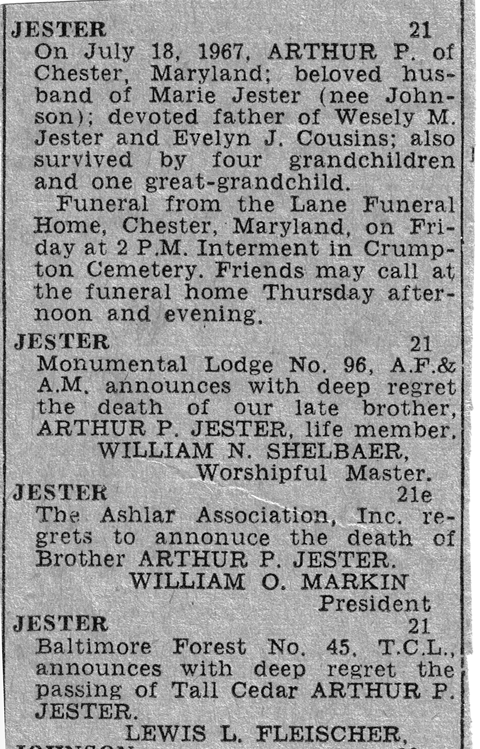
On 18 July 1967, he died of a Myocardial Infarction, a heart attack. Contributing to his death was Pulmonary Malignancy, and Rheumatic Heart disease.
His obituary was printed the next day.
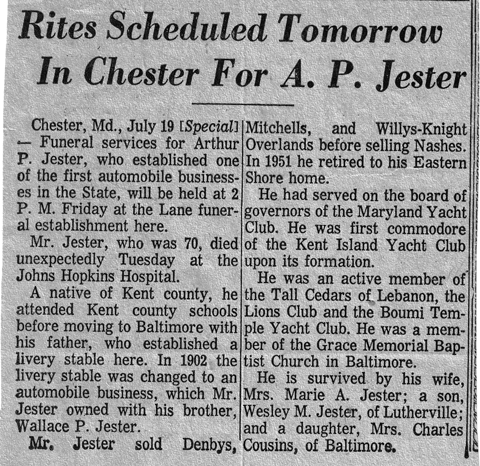
On the 21st of July 1967, the Baltimore Sun newspaper ran his death notice.